Sharing knowledge in Project, Program, Portfolio Innovation Management (PPIM) and various Technology.
Tuesday, November 4, 2025
Monday, November 3, 2025
Saturday, August 7, 2021
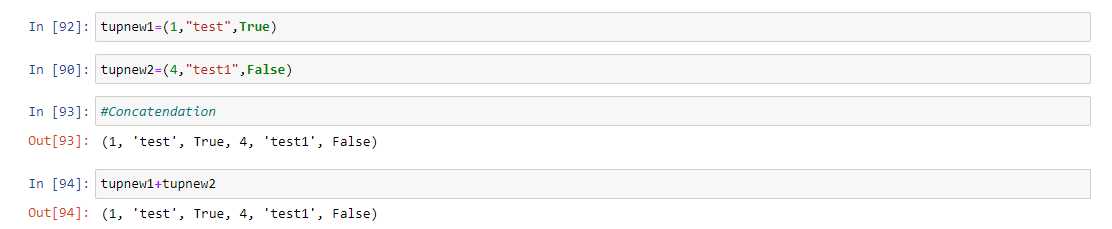
Tuples in Python
1. Tuple are immutable and basically can't change the values inserted.
2. Use Parenthesis ()
3. Sequential Order
Also will learn
Read tuple
- Repeat Tuple (*) & Concatenate Tuple (+)
- Max Value

My first basic programming in Python via Jupyter Notebook
I have tried basic programming using print and identifying the different data type.
In specific about complex type
Friday, August 6, 2021
Variables and Data-types in Python
Compare to other programming languages, one big difference in Python you no need to declare the variable type.
for example
employee_name = "bala"
employee_name
in the above example I didn't declare the variable type called string. but it takes automatically.
its known as dynamically typed programming.
In addition to Int, float, Boolean and String we have datatype called "Complex"
Complex data type example
a1=3+5j
type (a1) = complex
Saturday, July 31, 2021
Python Installation
1. Install python
Installed Python 3.9 for Window 10 version. It supports about Windows 9.
Link to download : https://www.python.org/downloads/
It supports Mac OS as well and refer the link provided for all the details.
Keep moving.
Python Introduction and exploring
Hi All,
I am back to programming and am exploring Python now and going to share lot of content relevant to Python including my experience in various real time projects.
Keep watching and happy learning in Python.
Thursday, May 30, 2019
Strategy Planning (Yearly plan and daily review)
It is a wonderful model being implemented by the greatest organization today. but it was there in history whereas Chanakya has to maintain the financial data and need to inform the king by checking every day.
Just to share high level about my current project.
Over a three month from January 2019, I am working in a new critical project as a project manager
When I took over it has a huge backlog and had a lot of dissatisfaction with the customer from a various market in the world.
This was one of the most dynamics projects worked as a project manager. in the month of May 2019 have reduced most of the backlogs on and by doing the planning and daily review.
In addition to daily review, we do have daily connect with the customer to help more making them confident.
This technique may be simple but more effective.
I may keep posting like these going forward since last 2 years working on critical projects and go live in the field of information technology.
Sunday, May 26, 2019
Friday, May 24, 2019
Thursday, November 2, 2017
About requirements - PMI PBA
-- functional requirement
-- non functional requirement
2. What is Business requirement.
What type of requirements describe the higher level needs of the organization as a whole ?
3. What is stakeholder requirement ?
what type of requirements describe the need of stakeholder or stakeholder group.
4. What is solution requirement ?
What type of requirements describes the function, features, characteristics of product, services or result that meet the business and stakeholder requirement.
5. What are functional requirement?
They describe the behavior of the product.
6. What are non-functional requirement?
They describe the environmental conditions qualities require for the product to be effective.
7. what is transition requirement ?
what type of requirements describe the temporary capabilities such as data conversion and training requirement needed to transition from As-is to to-be state.
8. What are project requirements?
They describe the actions, processes or other conditions the project needs to meet.
9. what are quality requirements ?
what type of requirements capture any conditions or criteria need to validate the completion of the project deliverable, or fulfill the other project deliverable.
10. What are techniques ?
A discipline or methods for carrying out a task.
11. iterative projects are ? time boxed, multiple phases.
PMI-PBA Some General questions Need assessment and Planning, Analysis, Traceable and Monitoring and Evaluation
1.A skilled Facillitator is needed to effectively elicit requirements
2.When facilitating rely on Agenda's and Ground rules.
3.What should be used to control scope =Traceability matrix
4.What type of skill is critical for elicitation of the requirements : Interviewing.
5.What is the goal of the need assessment domain?
to fully articulate the purpose and goals for effective solution.
6.The activities in which domain contribute to the development of business case and subsequent charter for a project. : Need assessment.
Planning
1. What is the goal of planning domain ? To plan the activities to be completed and the business analysis processes that the project will utilize.
2. Which domain includes the planning for requirement elicitation, management, approval, communication plan, and version control. (Planning)
3. A BA Plan is a typical input to what? A project plan.
4. Planning focus on both Deliverable and activities led by the BA as well as the process that will be used by the project team to support the BA work.
Analysis
1. What is the goal of analysis domain? To use appropriate technique to elicit and analyze process that the project will utilize.
Traceability and Monitoring
1. What is the goal of Traceability and monitoring domain ? to manage the requirement thorough the project life cycle.
2. Task related to managing requirement and communicating requirement to stakeholder through the project called which domain , traceability and monitoring.
Evaluation
1. What is the goal of Evaluation domain. ?
to evaluate the deliverable's and solution to ensure to meet the business need.
1. What is Business analysis?
To set of activities performed performed to identify business needs, recommend relevant solutions and elicit, document and manage requirements.
2. Solution may result in Products, services, or end result of a project or program.
3.What solves a problem or takes an advantage of opportunity to meet a business need ?
Solution
4.A condition or capability that is required to present in product, service or result to satisfy a contract or other formally imposed specification describes what ? requirement.
5. what are the various types of requirements ?
Business, stakeholder, solution, transition, project and quality.
what are the major themes of the PMI-PBA?
2. Be flexible and adaptable
3. Control control
4. Elicitation Keys
Saturday, October 28, 2017
Kano Model, Functional decomposition, Document Analysis, Data Dictionary & Glossory
To identify the customer satisfaction based on the implementation.
2. Functional Decomposition
The purpose of decomposition is to decompose processes functional areas, or deliverable's into their self contained component parts allow each part to be analyzed independently
Larger functionality, decompose
Top level function
sub function
Decomposed to sub processes and activities, features and so forth
Decomposition will help to get the WBS
Lower leave is work package.
It creates conceptual model of the work
Dividing and subdividing larger functionality into independent sub functionalities.
3. Document Analysis
The purpose of document analysis is to elicit requirement by studying available documentation on existing and comparable solutions and identifying relevant information.
Document analysis is especially useful when SME(s) are not available or are not going to be available throughout the duration of the elicitation process.
4. Data Dictionary & Glossory
Two types
1. Primitive
2. Composite
Friday, October 27, 2017
PMI-PBA Force Field Analysis, Acceptance Criteria,Bench Marking, RCA, Interface Analysis,Lessons Learned, Pareto Chart
Force field analysis will help to identify the positive and negative force against the solution.
How to make my solution win and need to find out the optimum way.
2. Acceptance Criteria/Fit Criteria/Test Completion Criteria
BA defines the acceptance criteria
3. Bench Marking
- Bench marking is a tool will analyse the strength and weakness of the company against competitor.
- Do not compare Apple with orange.
- Its time consuming and blocks innovation.
4. RCA (Root Cause Analysis)
The purpose of root cause analysis is to determine the underlying root cause of a problem.
Root cause analysis used to facilitate team members to continue pushing back to the root causes of an effect or a problem
RCA - Structured examination
1. Fish bone analysis (Ishikawa or cause and effect diagram)
2. 5 why analysis
1. Effect Identification
Effect will be presented to the team to identify the cause of the problem
2. Brain storm broader categories and sub categories
3. further sub categories identification
4. Get the Fish bone
The process will be repeated until we get the root cause of the problem, Example Fish Bone Diagram.
Interface Analysis
Why interface analysis needed ?
- To identify communication rules between two different component.
How does it help?
Anticipation in delivery date and collaboration between different applications.
Interface elements ?
interface identification preparation, conduct interface identification and define interfaces.
Lessons Learned
1. The purpose of lessons learned process is to improve the performance of future projects or project phases.
- Opportunities for improvement
- Document success
- Failures
It can be formal or informal
Format of lessons - Should be usable for key stakeholders
Pareto Chart
Pareto chart is a useful technique to understand the most effecting area of the requirement
Using this we can identify MMF - Minimum marketable features or Threshold features.
MMF -- MOSCOW ----> Must have.
Kano ---->Threshold.
Way to identify features which produce maximum value - vital few